These weeks in Labor: August

It’s been awhile, I spent most of August on vacation, travelling through a few cities. I had a lot of really cool conversations with friends active on campaigns based in electoral politics, community issues, and–of course–unionizing graduate workers. It’s only encouraged me to continue keeping track of what’s happening within higher education.

Here are some stories that have been happening in the past month: The gubernatorial race in New York features Cynthia Nixon as the progressive challenger against the Cuomo dynasty. Andrew Cuomo has been running hard on the Excelsior program. Started in 2016, Excelsior was supposedly Cuomo’s proposal to make public higher education free to students. Unfortunately, the number of requirements to qualify for such a scholarship make them unicorns on most campuses. A recent report concludes only 3.2% of students benefited from the program in 2017-2018. Over two-thirds of undergraduates were rejected for not making sufficient progress on their degrees. Much like every other aspect of Cuomo’s campaign, he is only interested in appearing progressive, while securing power for himself. Nixon, on the other hand, is running on an expansion of Excelsior with minimal requirements, hoping to open the program to seven times as many students.

(If you live in Brooklyn’s 18th district, Julia Salazar’s state senate campaign also calls for free tuition throughout the CUNY and SUNY systems. She’d have my vote.)

In mid-August, Goucher joined the increading list of schools to cut back on majors and departments considered not in-demand on the basis of course subscriptions. Called “Academic Revitalization,” Goucher’s Provost insisted that this was a consequence of the university’s decision to freeze tuition, linking the loss of tuition to the need to lower costs. This is despite the ratio of their endowment to current student body being $153,000 (400 million to about 2600 students). Nevertheless, this will become an increasingly popular tactic: to connect the loss of tuition revenue through concern with making college affordable to reductions in educational capacity for departments that cannot find undergraduate majors, especially as we reach the limits of tuition. Imagine making bolder arguments for an education that goes beyond a liberal conception of buying and paying for services.

Since June, many academics have been following the case between Avital Ronnell, professor of philosophy and German Studies at New York University and Nimrod Reitman, formerly a graduate student who had studied with her. It was announced last week that Ronnell would be suspended after being found guilty of sexually harassing Reitman. There are several things that intrigue these academics about this case: chief among them seems to be the fact that a woman faculty member was found guilty of harassing a male student and that seemingly every progressive humanities academic has fallen in line supporting the faculty member.

More interesting to me is the fact that these correspondences–and Reitman said he was forced to mirror Ronnell’s language–betray an aspect of academia that has deeply bothered me. Because the “life of the mind” is painted as something that seizes your labor, your life, and your soul, it is often seen as perfectly normal to envision your advisors, your faculty members, and your peers as a family with whom you would exchange affection. Some portions of these affects include eroticism, as defended by Marta Figlerowicz & Ayesha Ramachandran in a Boston Review essay some months ago. If you’ve organized graduate workers, you’ve likely struggled against this ecology of affect and labor in presenting a vision of academia as a workplace like any other.

The professors who’ve signed a letter of support for Ronnell might know something we don’t; grads and faculty across the country in specific departments and fields often have better sense of the characters at hand than even the people down the hall. But they’ve yet to produce anything coherent beyond “Ronnell is eccentric and brilliant.” More likely, they view the relationship between Ronnell and Reitman as something that happens from time to time in academia, and have determined that, while not ideal, it is not worth filing suit over. That is exactly why graduate workers, postdocs, and part-time faculty need unions to protect themselves, collectively.

Silent Sam is down. Check out the Workers Union at UNC (Twitter and Facebook) for links and feeds about this statue and the brave protestors and organizers who toppled this statue to the Confederacy. Also, donate to Durham’s bond fund, which is being used to bail out protestors on the front lines.

These Weeks in Academic Labor (July 1 – July 15th)

Southern Illinois University President Randy Dunn will finally resign after a tumultuous spring. His tenure had been marked by a number of attempts to divert $5.1 million from SIU’s Carbondale campus to Edwardsville, culminating in a leaked email where the President referred to the faculty and staff at Carbondale as “bitchers” that they needed to shut down.

While this email received the lion’s share of attention for folks following the story, it was not what ultimately got Dunn fired. Instead, as the Chicago Tribune reports, the Board of Trustees behind SIU felt slighted by these efforts to divert funding from Carbondale, suggesting that the president had failedin his mandate to check in and inform the Board as to what he was doing.

This is ultimately the reason why presidents and provosts at the upper levels of many college administrations do not capitulate to the demands of their faculty and students. The Board of Trustees can determine when and where a president resigns if they step out of line in the slightest. This is an economic situation that can and needs to change if we’re going to resolve the crisis of higher education.

Dunn walks away with 215,000 worth of severance, and a year-long faculty appointment at $100,000 beginning January 2019. Even when they fail, higher-level administrators don’t fall quite as hard as the rest of us might.

In slightly better news, lecturers at the University of Michigan—AFT-Local 6244—announced that they had ratified a contract, with 98% of participating voters saying yes. The contract represents significant victories at the bargaining table, holding for three years, in which the minimum entry salary jumped from $34,500 to $51,000, and the minimum salary for Lecturer Is went from $27,000 to $41,000. In addition to these stunning increases in pay, the University will also expand their contribution to employee’s retirement funds, healthcare coverage is stronger, and job security—especially where job performance reviews tied to testing are concerned—are visibly stronger for lecturers. It turns out organizing can lead to some significant advances in the workplace.

 The founder of a consulting firm called Ed4Mil pleaded guilty to defrauding the 9/11 GI Bill. The fraud charged veterans up to $20,000 a course for classes Ed4Mil said were accredited by Caldwell University. In reality, the courses were only correspondence courses that had cost the firm $1,000 each to produce. Over the course of four years, the firm produced $24 million in profits.

This is only the latest grift to take advantage of the post-9/11 GI Bill, designed to enable veterans of Iraq and Afghanistan to attend college without going into debt. While ostensibly good, the program has few to no protections about what universities and colleges count for these funds. One goal of the PROSPER act defeated in the house a month ago was to include for-profit institutions like the University of Phoenix as places where vets could spend these college credits. Trump University also milked the GI bill for every dime it could before settling out of court.

In a doozy of a story, West Virginia is the battleground between several camps over the political and economic influence of its public universities. On July 12, the Higher Education Policy Commission announced the appointment of Carolyn Long as interim chancellor, charged with overseeing expenditures and asset allocation for WV’s public schools. This chancellor was previously the president of West Virginia University’s Institute of Technology, an experience that critics argue would make her favor West Virginia University on a whole.

This unprecedented appointment comes on the heels of an education budget designed to balance the amount of money available to institutions beyond West Virginia University. Schools like Sheperd University have endured the brunt of austerity in higher education and would have received moderate increases in their budgets, at the expense of schools like Western Virginia University. The appointment of Long as chancellor makes the passing of this budget a longshot. Lurking in the background is a blue-ribbon commission organized by Republican Governor Jim Justice charged with examining higher education in West Virginia. Given parallels with other GOP governments in North Dakota, Nebraska, and Montana, it is unlikely that this commission is meant to benefit higher education.

These Weeks in Academic Labor (June 17th – June 30th)

capybara-mother-babies
This has been a tough couple weeks; have a capybara picture


On June 21st,
AFT announced that an agreement had been reached between Stand Up for Graduate Student Employees (SUGSE) and their employers for a union election away from the National Labor Relations Board. The agreement comes after a year of negotiations with their employer and two and a half years of getting the majority of their bargaining unit onto cards. I won’t rehash what I’ve already written about this agreement, but it is important to emphasize the role of public pressure and direct action in moving employers to recognize and negotiate with unions in higher ed.

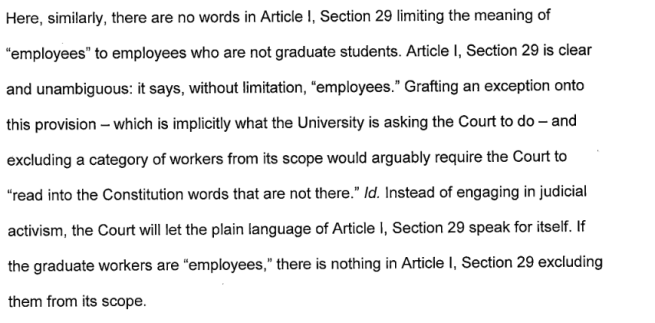
Also last Thursday, a judge ruled against the University of Missouri, which has spent three years challenging its graduate employees in as to whether or not they were actually employees. It’s worth smiling at this paragraph especially:

Screen Shot 2018-06-30 at 7.30.22 PM
lol, owned.

The University of Missouri had denied an election to graduate workers twice over the course of a year. After the second denial, the Coalition of Graduate workers held an election with the assistance of the League of Women voters, in which 84% voted for union representation (30% of the bargaining unit participated).  The judge not only held that Missouri’s graduate workers were workers, but also that the University of Missouri waived its right to contest the vote when it refused an election to their workers. You can read the decision here.

On Thursday, Western Illinois University announced their intention to lay off 24 faculty members, including 7 with tenure. In addition, 62 vacant faculty positions will be eliminated entirely. These eliminations were part of a charge handed down from the Board of Trustees to line up Western Illinois with the reduction of funding and declining enrollments they have seen, its president going so far as to say that “Western Illinois can no longer be all things to all people.” Their announcement also suggested they hoped public funding from the state government in Illinois would return in the next few years to aid the deficit WIU is facing. Given the billionaire race between JB Pritzker and Bruce Rauner for the Governor’s seat, this hope seems more fantasy than reality.

Early Friday morning, a Portland State University police officer murdered Jason Washington, a postal worker and father to three daughters. He was trying to break up a fight, when his own holstered gun dropped, and the police opened fire when he went to pick it up.

Firearms aside, it is a fact that the Board of Trustees at Portland State University voted to arm police officers in 2015, against the recommendations of students and the faculty and graduate student members of the Board of Trustees. The strongest argument made in that debate appeared to be retaining school control over armed police officers, as opposed to retaining the Portland Police Bureau. In any case, the ten new armed officers are costing the university about $1.2 million a year. If you’re interested, check out this plan for the implementation of these armed police officers.

On Wednesday, full and adjunct faculty and postdocs at Oregon State University announced that they had successfully unionized after years of organizing. The 2,400 individuals represented by the new AFT-AAUP affiliated union represent faculty at the Corvallis campus, the Bend and Newport campuses, and even faculty who teach primarily online. The news was especially welcome on the same day that the Janus decision brought Right-to-work policy to the public sectors throughout the United States.

I’ve evaded discussion of Janus because I think lots of folks are doing far better with it than me. Chris Maisano for Jacobin wrote an excellent essay that describes Janus as opening the door for a more militant labor movement than the sort of backroom negotiations and civil discourse that has dominated unions and labor since Clinton. As part of this perspective, I’ll be putting out a discussion with some organizers and members with UAW4121 about their strike action sometime this week.

Incidentally, if you’re looking for a change in career, California is seeking two full-time organizers with salaries starting at $62k; more info here.

Graduate Workers at Brown Announce Pre-Election Agreement with Their Administration

33598380_625349847819578_5527022542243495936_n
Happy and excited SUGSE Grad workers are excited to tell Tom Perez they are #UnionStrong

Disclaimer: Given that I was both a member of the Negotiations Team for this agreement and a current member of SUGSE, I must clarify that this update is provided by me as an individual graduate worker and not as a representative for either of these groups.

On Thursday, Stand Up for Graduate Student Employees (SUGSE), affiliated with Rhode Island Federation of Teaching and Health Professionals and the American Federation of Teachers, and Brown University announced together that they signed a pre-election agreement to oversee conduct for a union election. Among other things, the agreement allows graduate workers to hold an independent election with the American Arbitration Association (AAA), and should they win such an election, compels Brown to bargain in good faith. This agreement is only the second such agreement to be signed since Columbia, and the first within the Ivy League.

Continue reading “Graduate Workers at Brown Announce Pre-Election Agreement with Their Administration”

These Weeks in Academic Labor (June 2nd – June 16th)

On June 4th, workers at UAW4121 approved the contract offered by their employers, the University of Washington, by a 62-38 ratification vote. The contract moved on issues like orientation and sexual harassment language, offered some compensation and bargaining opportunities for the variety of fees it charges graduate workers, while still retaining the 2% raises initially proposed by the employer. The contract represents a significant win for the local, which had been bargaining since February, but the cost of living in Seattle especially has dramatically outpaced 2%. The contract is set for three years, I’ll be writing a little more about this later on in the week.

Continue reading “These Weeks in Academic Labor (June 2nd – June 16th)”

Academic Austerity: Land Over Labor

32046095644_f704ebbe60_b
Monroe Street Market Development, opened in 2014, funded for $200 million by Catholic University. To the right is Gibbons Hall, and the Basilica of the National Shrine of the Immaculate Conception

The Board of Trustees at Catholic University voted June 4th on a plan that cut thirty-five faculty members from a variety of academic departments. The plan had been approved by the Faculty Senate on May 9th, and is the culmination of work over the past few years designed to close the gap from declining tuition revenue, this year amounting to about $3.5 million. Academic reduction plans are often branded as commitments to educational integrity, and Catholic University saw no reason to break with this trend, titling the plan “Academic Renewal.

Continue reading “Academic Austerity: Land Over Labor”

These Weeks in Academic Labor (5/16 – 6/1)

May 16th, 2018: Adjunct faculty of the University of Iowa affiliated with Faculty Forward Iowa (a member of SEIU) met with employers with the University of Iowa to begin discussion about the state of employment and conditions impacting faculty within the university. While UI President Bruce Harreld has said he would not recognize FFI as a bargaining unit, these meetings began after adjunct faculty occupied his office the week before.

Iowa is a right-to-work state, where legislatures and the executive branch are controlled by Republicans. As such, FFI has developed a direct confrontation strategy that continues to escalate against their employers until they voluntarily recognize and secure good working conditions for their membership. For more information, see an assessment of this strategy published by The Nation in the broader context of a political environment controlled by the hard right. Also follow FFI on Facebook.

May 30th, 2018
: Last Wednesday, faculty at Western Illinois University voted 75% (with 68% turnout) to accept a new employment contract that cuts faculty salaries and other benefits. Starting from 2017-2018, the contract runs for four years, and will reduce salary caps by 2% and salaries for summer teaching by 15%. The new contract does give more parental leave and promotional benefits for part-time faculty, but was described by the union’s negotiations team as a cost savings measure.

Important to note: The initial proposal for the contract had furlough days, and 3% annual cuts worked into it. What pulled the administration back to the bargaining table was the threat of a general strike, authorized in April. This serves as yet another reminder that strikes work when it comes to pushing our issues and advancing our demands.

May 31st, 2018: Negotiations continue between the graduate workers across the University of California system and their employers. Most recently, their employers have proposed a 2% raise (compared to 3.4% inflation in California), and continue to refuse to move toward the union’s proposals.

Earlier in May, the employer insisted on putting a hold on union grievance procedures on grievances that deal with sexual harassment or violence until after the Title IX investigations concluded. Not only is this undemocratic––employees represented by the union voted on their grievance procedures––but the failures of Title IX have become some of the most infamous stories within higher education for both graduate and undergraduates. Rarely will universities actually discipline faculty members for assault, and when individuals are held responsible, it is often unclear through what mechanisms they are found innocent or guilty.

For more on title IX, see Marina Bolotnikova’s thoughtful assessment on the loss of due process within Title IX especially from Obama onwards, the failure of Title IX to stop Larry Nassar at Michicgan State, the problems facing undergraduate and graduate workers with Harvard’s Title IX process and the specific failure of Title IX to protect graduate workers from David Marchant at Boston University, their department chairs hoping the sexual assault would go away. 

June 1st, 2018: On Friday, graduate workers affiliated with UAW4121 received a contract proposal from their employers at the University of Washington. The contract proposal came just before a two-week long strike would have taken place between June 2nd and the 15th. Graduate workers are currently voting on whether or not to ratify the proposed contract. Graduate workers had previously held a one-day strike, which appeared to accelerate negotiations while forcing the administration into making a series of statements.

While the bargaining team for graduate workers recommends taking the contract, and a majority of the bargaining unit appears to support it, it is clear the University of Washington has played hardball. According to a support statement from SEIU, the University threatened to resolve the strike through the hiring of adjuncts who would teach for lower salaries and no health care. Simultaneously, a number of graduate workers from UAW4121 (Here and here) have clearly shown the vast distance between the rhetoric of their employers, and the economic reality. UAW4121’s twitter account seems to be keeping folks up to date.

Another fun story developing: Niall Ferguson, the “West before the Rest” guy, resigned his role at Stanford’s “Free Speech” program, after suggesting that conservative undergraduates do opposition research on another left-wing student on the campus. More thoughts on this later, but remember that there is a free speech crisis on campus, but it is not the one advanced by Ferguson or any of the typical pundits covering the topic.

While you’re here, Loyola University’s graduate workers have an ask:


Illinois: Research Assistants Are Eligible for Collective Bargaining

Foellinger_Auditorium_University_of_Illinois_at_Urbana-Champaign_closer
Foellinger Auditorium at the University of Illinois Urbana-Champaign

The Illinois General Assembly successfully passed SB2546 this week, which considers graduate research assistants at public universities as employees for the purposes of collective bargaining. Whereas the Illinois Educational Labor Relations Act only granted those workers acting as teaching assistants the possibility of collective bargaining, SB2546 amends this definition to also include graduate workers whose stipend comes from labor they do in a faculty’s lab or research project. Continue reading “Illinois: Research Assistants Are Eligible for Collective Bargaining”

These Weeks in Academic Labor (May 1 – May 14)

Graduate workers at George Washington University held an eight-hour sit-in last Thursday, the second in two weeks, demanding that their employer permit a neutral party to administer a union election. The demand follows in the wake of their colleagues at Georgetown University, who successfully pressured their employer into an election agreement that enables them to hold a vote outside of a Trump-controlled labor board last month. Without such an agreement, any election threatens the rights of graduate organizers everywhere to hold union elections.

Continue reading “These Weeks in Academic Labor (May 1 – May 14)”